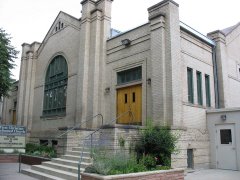
Working on Daniel 4 this week, I was reminded of the opening line of John Calvin's Institutes.
"Nearly all the wisdom we possess, that is to say, true and sound wisdom, consists of two parts: the knowledge of God and of ourselves."
Hopefully, we'll take a few steps in the direction of that "true and sound wisdom" this (and every!) Sunday morning.
Thursday, January 31, 2008


Tuesday, January 29, 2008
Obedience
On Sunday morning, I quoted Sietze Buning's (Stanley Weirsma's) poem Obedience. However, I left out what I think may be the best part (the last few paragraphs). So for your pleasure (and pondering), here it is in full:
Were my parents right or wrong
not to mow the ripe oats that Sunday morning
with the rainstorm threatening?
I reminded them that the Sabbath was made for man
and of the ox fallen into the pit.
Without an oats crop, I argued,
the cattle would need to survive on town-bought oats
and then it wouldn't pay to keep them.
Isn't selling cattle at a loss like an ox in a pit?
My parents did not argue.
We went to church.
We sang the usual psalms louder than usual--
we, and the others whose harvests were at stake:
"Jerusalem, where blessing waits,
Our feet are standing in thy gates."
"God be merciful to me;
On thy grace I rest my plea."
Dominie's spur-of-the-moment concession:
"He rides on the clouds, the wings of the storm;
The lightning and wind his missions perform."
Dominie made no concessions on sermon length:
"Five Good Reasons for Infant Baptism,"
Though we heard little of it,
for more floods came and more winds blew and beat
upon that House than we had figured on, even,
more lighting and thunder
and hail the size of pullet eggs.
Falling branches snapped the electric wires.
We sang the closing psalm without the organ and in the dark:
"Ye seed from Abraham descended,
God's covenant love is never ended."
Afterward we rode by our oats field,
flattened.
"We still will mow it," Dad said.
"Ten bushels to the acre, maybe, what would have been fifty
if I had mowed right after milking
and if the whole family had shocked.
We could have had it weatherproof before the storm."
Later at dinner Dad said,
"God was testing us. I'm glad we went."
"Those psalms never gave me such a lift as this morning,"
Mother said, "I wouldn't have missed it."
And even I thought but did not say,
How guilty we would feel now if we had saved the harvest.
The one time Dad asked me why I live in a Black neighborhood,
I reminded him of that Sunday morning.
Immediately he understood."
Sometime around the turn of the century
my sons may well bring me an article in The Banner
written by a sociologist who argues,
"The integrated neighborhoods of thirty years ago,
in spite of good intentions,
impaired Black self-image and delayed Black independence."
Then I shall tell my sons about that Sunday morning.
And I shall ask my sons to forgive me
(who knows exactly what for?)
as they must ask their sons to forgive them
(who knows exactly what for?)
as I have long ago forgiven my father
(who knows exactly what for?)
Fathers often fail to pass on to sons
their harvest customs
for harvesting grain or real estate or anything.
No matter, so long as fathers pass on to sons
another more important pattern
defined as absolutely as muddlers like us can manage:
obedience.
Seitze Buning, in Purpaleanie and other Permutations
The Middleburg Press, Orange City, IA. 1978.
Were my parents right or wrong
not to mow the ripe oats that Sunday morning
with the rainstorm threatening?
I reminded them that the Sabbath was made for man
and of the ox fallen into the pit.
Without an oats crop, I argued,
the cattle would need to survive on town-bought oats
and then it wouldn't pay to keep them.
Isn't selling cattle at a loss like an ox in a pit?
My parents did not argue.
We went to church.
We sang the usual psalms louder than usual--
we, and the others whose harvests were at stake:
"Jerusalem, where blessing waits,
Our feet are standing in thy gates."
"God be merciful to me;
On thy grace I rest my plea."
Dominie's spur-of-the-moment concession:
"He rides on the clouds, the wings of the storm;
The lightning and wind his missions perform."
Dominie made no concessions on sermon length:
"Five Good Reasons for Infant Baptism,"
Though we heard little of it,
for more floods came and more winds blew and beat
upon that House than we had figured on, even,
more lighting and thunder
and hail the size of pullet eggs.
Falling branches snapped the electric wires.
We sang the closing psalm without the organ and in the dark:
"Ye seed from Abraham descended,
God's covenant love is never ended."
Afterward we rode by our oats field,
flattened.
"We still will mow it," Dad said.
"Ten bushels to the acre, maybe, what would have been fifty
if I had mowed right after milking
and if the whole family had shocked.
We could have had it weatherproof before the storm."
Later at dinner Dad said,
"God was testing us. I'm glad we went."
"Those psalms never gave me such a lift as this morning,"
Mother said, "I wouldn't have missed it."
And even I thought but did not say,
How guilty we would feel now if we had saved the harvest.
The one time Dad asked me why I live in a Black neighborhood,
I reminded him of that Sunday morning.
Immediately he understood."
Sometime around the turn of the century
my sons may well bring me an article in The Banner
written by a sociologist who argues,
"The integrated neighborhoods of thirty years ago,
in spite of good intentions,
impaired Black self-image and delayed Black independence."
Then I shall tell my sons about that Sunday morning.
And I shall ask my sons to forgive me
(who knows exactly what for?)
as they must ask their sons to forgive them
(who knows exactly what for?)
as I have long ago forgiven my father
(who knows exactly what for?)
Fathers often fail to pass on to sons
their harvest customs
for harvesting grain or real estate or anything.
No matter, so long as fathers pass on to sons
another more important pattern
defined as absolutely as muddlers like us can manage:
obedience.
Seitze Buning, in Purpaleanie and other Permutations
The Middleburg Press, Orange City, IA. 1978.
Praying for Your Pastor
Flipping through Ephesians on Sunday night, I found a pastoral prayer request that ties in well with my last post. Paul says: Pray for me, that whenever I open my mouth, words may be given me so that I will fearlessly make known the mystery of the gospel...Pray that I may declare it as fearlessly as I should. (Ephesians 6:19-20)
A good one for Paul...and a good one for me!
A good one for Paul...and a good one for me!
Friday, January 18, 2008
The Revealer of Mysteries: Take 2
I encountered what could only be referred to as irony in my sermon preparation this week. I've been doing my best to write a compelling, relevant, biblical sermon on Daniel 2--and on the "Revealer of Mysteries" that is so frequently referred to there. But in the meantime, I've felt enshrouded in mystery myself. For some reason, I can't seem to see this text with the clarity I would like. I've found myself keeping company with Nebuchadnezzar--tossing and turning at night as I try to understand what God is trying to "reveal" to us in all of this.
Come Sunday (barring major a major revelation in the next 48 hours), I'll be talking about how God's knowledge of the future assures us of his control of the future. But I've also thought--more than once--that this text might take us a different direction.*
It seems to me that old Nebuchadnezzar is on a quest for truth in this passage. He's looking for a kind of truth that doesn't come about through human intuition, or the standard Babylonian ways of knowing that he had long depended on. This methods of knowing the deeper mysteries of life are ultimately insufficient and not dependable. Nebuchadnezzar needs something more. He needs a revelation from God. (That's why he ups the ante with his court astrologers and has them tell the dream--because he wants to know that they can be trusted).
The parallel is less exact than I'd like (and that's one of the reason's I didn't preach this) but it seems to me that there may be a very strong Christ connection in this passage. After all, Paul frequently refers to Christ as the "mystery of God" (do a search--it's rather fascinating. Or start with Col 1:25-2:5, 1 Cor. 15)**. The question for us then becomes how we can know the truth about the mystery of Christ.
There are plenty of places to start when we're searching for the "meaning of the mystery" that is Christ. Apologetic arguments, intuition, the words and witness of passionate believers. But in the end, our conviction of the truth of this mystery will not come from our normal sources of understanding; it will not come from our quest to discover and discern Christ. Ultimately, it will come from God's movement toward us. It will come from his act of revelation. And if we take Daniel's actions as a cue, it will only come when we step out in faith and enter a relationship (prayer) with him.
I think it's something worth considering. I know some folks (some readers here?) who are curious about the Christian faith, curious about Christ, but don't know how they can know for certain. To them, I'd say--step out in faith. Pray that God will reveal this truth to you (or to your loved ones). Or if you're a person who struggles with day to day doubts, with the plausibility of what we confess to be true as Christians (which most of us who think about these things will do at some point)--pray to God to reveal the mystery to you. Ask him to give you true wisdom and insight into the certainty of life with Christ.
*More than one, actually. If I get around to it, I'd like to jot down a few things on the politics of Daniel 2.
**A connection can also be made with the "wisdom" idea that comes in Daniel's Song (Chap 2.20 ff)--God gives wisdom, and the wisdom of God is the foolishness of the world--the cross of Christ that we know through the Spirit. Cf. 1 Cor 1
Come Sunday (barring major a major revelation in the next 48 hours), I'll be talking about how God's knowledge of the future assures us of his control of the future. But I've also thought--more than once--that this text might take us a different direction.*
It seems to me that old Nebuchadnezzar is on a quest for truth in this passage. He's looking for a kind of truth that doesn't come about through human intuition, or the standard Babylonian ways of knowing that he had long depended on. This methods of knowing the deeper mysteries of life are ultimately insufficient and not dependable. Nebuchadnezzar needs something more. He needs a revelation from God. (That's why he ups the ante with his court astrologers and has them tell the dream--because he wants to know that they can be trusted).
The parallel is less exact than I'd like (and that's one of the reason's I didn't preach this) but it seems to me that there may be a very strong Christ connection in this passage. After all, Paul frequently refers to Christ as the "mystery of God" (do a search--it's rather fascinating. Or start with Col 1:25-2:5, 1 Cor. 15)**. The question for us then becomes how we can know the truth about the mystery of Christ.
There are plenty of places to start when we're searching for the "meaning of the mystery" that is Christ. Apologetic arguments, intuition, the words and witness of passionate believers. But in the end, our conviction of the truth of this mystery will not come from our normal sources of understanding; it will not come from our quest to discover and discern Christ. Ultimately, it will come from God's movement toward us. It will come from his act of revelation. And if we take Daniel's actions as a cue, it will only come when we step out in faith and enter a relationship (prayer) with him.
I think it's something worth considering. I know some folks (some readers here?) who are curious about the Christian faith, curious about Christ, but don't know how they can know for certain. To them, I'd say--step out in faith. Pray that God will reveal this truth to you (or to your loved ones). Or if you're a person who struggles with day to day doubts, with the plausibility of what we confess to be true as Christians (which most of us who think about these things will do at some point)--pray to God to reveal the mystery to you. Ask him to give you true wisdom and insight into the certainty of life with Christ.
*More than one, actually. If I get around to it, I'd like to jot down a few things on the politics of Daniel 2.
**A connection can also be made with the "wisdom" idea that comes in Daniel's Song (Chap 2.20 ff)--God gives wisdom, and the wisdom of God is the foolishness of the world--the cross of Christ that we know through the Spirit. Cf. 1 Cor 1
Friday, January 11, 2008
A Rant: Removing the Roadblocks
Pardon me, but I need to rant a bit today. That means this post will undoubtedly include some ridiculous overstatement, silly generalization, or other ungodly use of words. So I ask your forgiveness in advance. But I just can't help myself.
My rant is in response to an email I received recently. It was from a dear friend who was looking for a book recommendation. The book was not for him, but for a family member who apparently has turned her back on the Christian faith (any book recommendations out there?). While explaining his request, he gave a fistful of reasons for her rejection, but the one that really stuck in my craw was one I've heard all too often. This young woman--a bright student in finishing her masters degree in biology at a large university--is under the impression that you can't be a Christian AND be an intelligent scientific thinker. Her proof? The (misinformed) impression she has that all Christians believe (and must believe) that dinosaurs never existed, that the earth is 6,000 years old, that there is no such thing as evolution in any shape or form.
Don't get me wrong. You are entitled to conclude from your reading of Genesis 1-2 that God created the world in a very short time (even 6, 24 hour days). You may believe, if you really think it best, that the dinosaur bones that have been found just west of Denver were a part of God's elaborate plan to create a young earth that merely looked old (on par with giving Adam and Eve belly buttons). You can even insist that the earth is a mere 6,000 years old. You may think all those things and I will have no beef with you. Just don't tell me that I have to believe all those things. More importantly, don't tell my young friend that she has to.
There are a lot of reasons I'd prefer Christians don't run around insisting on this narrow interpretation of Scripture. For one, I (and many other Bible-believing Christians) believe that there are other (better?) ways to interpret the text--ways that remain faithful to Genesis' original intent but not at odds with scientific findings. I think that looking to Genesis 1 to see just how old the earth is and exactly "how it happened" is starting in the wrong place--that when we do that we're asking questions the text isn't trying to answer. I think that the text may not be trying to tell us exactly how God created the cosmos (I can't understand why God would think it necessary to tell us that--first thing!)--but that he created it (I can understand why God would want us to know that). I may elaborate on that in a later post (depending on how much trouble I get in for this one), but that's not really my main point here. My main point is that there are sound reasons for having a different understanding of Genesis 1 and that to insist that there is only one--and that it's the one that seems to contradict so much science--is to put up an unnecessary roadblock to the Christian faith. I'd even go to say that, depending on the severity of the insistence, it may even be making the Christian faith about something it is not.
Let me explain that last sentence--and pardon the tangential thinking. Remember, this is a rant.
Here in Denver, it's not uncommon to see "Darwin Fish" plastered on the bumpers of the Subaru's in the King Soopers parking lot. You know the ones--they have fins, feet, and often, gaping mouths that are chomping down the "Jesus fish". There are probably a lot of things that could be said about those fish (either the Darwin fish or the Jesus fish). But for today, just take a moment and notice the interest pairing that is happening here. The Darwin symbol--which represents one interpretation of the way the world came about--is paired with a Jesus symbol. I don't expect anything on a bumper to be too profound, but in my mind, this should be an apples to oranges comparison--a confusion of categories. After all, when I want people to know Jesus and to become Christians, what I want for them to know is all the life, salvation, holiness, joy, fulfilment, meaning, hope, and redemption that can be theirs in Christ Jesus...not some particular understanding of all the details of the way this world came about. To be sure, we have something to say about that as Christians--but it's not our main concern. Yet the pairing of the Darwin/Jesus fish on so many bumpers suggests that, at least in the minds of many (presumably) non-Christians--that is our (and Jesus'!) main concern. If that's the message we're sending, no wonder so many people remain disinterested--or even scornful--from the "Christian" faith.
That's one of the tragic ironies of all the energy that many Christians have been pouring into the Creationist debate. They've been fighting for "truth" in what may be considered a peripheral issue, but in the process have but up unnecessary roadblocks for those who might come to know the Truth, the way, and the life. In my mind, that is something worth ranting about.
My rant is in response to an email I received recently. It was from a dear friend who was looking for a book recommendation. The book was not for him, but for a family member who apparently has turned her back on the Christian faith (any book recommendations out there?). While explaining his request, he gave a fistful of reasons for her rejection, but the one that really stuck in my craw was one I've heard all too often. This young woman--a bright student in finishing her masters degree in biology at a large university--is under the impression that you can't be a Christian AND be an intelligent scientific thinker. Her proof? The (misinformed) impression she has that all Christians believe (and must believe) that dinosaurs never existed, that the earth is 6,000 years old, that there is no such thing as evolution in any shape or form.
Don't get me wrong. You are entitled to conclude from your reading of Genesis 1-2 that God created the world in a very short time (even 6, 24 hour days). You may believe, if you really think it best, that the dinosaur bones that have been found just west of Denver were a part of God's elaborate plan to create a young earth that merely looked old (on par with giving Adam and Eve belly buttons). You can even insist that the earth is a mere 6,000 years old. You may think all those things and I will have no beef with you. Just don't tell me that I have to believe all those things. More importantly, don't tell my young friend that she has to.
There are a lot of reasons I'd prefer Christians don't run around insisting on this narrow interpretation of Scripture. For one, I (and many other Bible-believing Christians) believe that there are other (better?) ways to interpret the text--ways that remain faithful to Genesis' original intent but not at odds with scientific findings. I think that looking to Genesis 1 to see just how old the earth is and exactly "how it happened" is starting in the wrong place--that when we do that we're asking questions the text isn't trying to answer. I think that the text may not be trying to tell us exactly how God created the cosmos (I can't understand why God would think it necessary to tell us that--first thing!)--but that he created it (I can understand why God would want us to know that). I may elaborate on that in a later post (depending on how much trouble I get in for this one), but that's not really my main point here. My main point is that there are sound reasons for having a different understanding of Genesis 1 and that to insist that there is only one--and that it's the one that seems to contradict so much science--is to put up an unnecessary roadblock to the Christian faith. I'd even go to say that, depending on the severity of the insistence, it may even be making the Christian faith about something it is not.
Let me explain that last sentence--and pardon the tangential thinking. Remember, this is a rant.
Here in Denver, it's not uncommon to see "Darwin Fish" plastered on the bumpers of the Subaru's in the King Soopers parking lot. You know the ones--they have fins, feet, and often, gaping mouths that are chomping down the "Jesus fish". There are probably a lot of things that could be said about those fish (either the Darwin fish or the Jesus fish). But for today, just take a moment and notice the interest pairing that is happening here. The Darwin symbol--which represents one interpretation of the way the world came about--is paired with a Jesus symbol. I don't expect anything on a bumper to be too profound, but in my mind, this should be an apples to oranges comparison--a confusion of categories. After all, when I want people to know Jesus and to become Christians, what I want for them to know is all the life, salvation, holiness, joy, fulfilment, meaning, hope, and redemption that can be theirs in Christ Jesus...not some particular understanding of all the details of the way this world came about. To be sure, we have something to say about that as Christians--but it's not our main concern. Yet the pairing of the Darwin/Jesus fish on so many bumpers suggests that, at least in the minds of many (presumably) non-Christians--that is our (and Jesus'!) main concern. If that's the message we're sending, no wonder so many people remain disinterested--or even scornful--from the "Christian" faith.
That's one of the tragic ironies of all the energy that many Christians have been pouring into the Creationist debate. They've been fighting for "truth" in what may be considered a peripheral issue, but in the process have but up unnecessary roadblocks for those who might come to know the Truth, the way, and the life. In my mind, that is something worth ranting about.
Thursday, December 13, 2007
Definitions: Some Thoughts on Forgiveness
One of the bright spots that has emerged through the darkness of Sunday's tragic shootings has been the declarations of forgiveness from the family and friends of the victims. Christians have taken notice and, quite significantly, so has the press.* As more than one person has said to me, we ought to be grateful for the positive example of people living out their faith in a forgiving God.
Others, however, have not been quite so sure. In a recent conversation, someone had the courage to suggest what many of us may have thought--that perhaps it was too soon to offer forgiveness, that maybe doing so trivialized what was, by all accounts, a very terrible wrong, or that doing so may have rushed a grief process in which anger would have played an important role.
These are all legitimate concerns--but I think they may stem from a misunderstanding of forgiveness. So a few thoughts today on what forgiveness does--and does not--involve.**
Others, however, have not been quite so sure. In a recent conversation, someone had the courage to suggest what many of us may have thought--that perhaps it was too soon to offer forgiveness, that maybe doing so trivialized what was, by all accounts, a very terrible wrong, or that doing so may have rushed a grief process in which anger would have played an important role.
These are all legitimate concerns--but I think they may stem from a misunderstanding of forgiveness. So a few thoughts today on what forgiveness does--and does not--involve.**
- Forgiveness is not a one time event. The individuals affected by Sunday's shootings declared their forgiveness almost immediately. However, it will take time for them to grow into this declaration. As I mentioned in a sermon on this topic last month, they will have to forgive--to make moves against their anger--again, and again, and again (seventy times seven!). I suspect that for some of these people (perhaps all of them) it will take years for forgiveness to be complete. As Smedes says, "Forgiving is a journey; the deeper the wound, the longer the journey."
- Forgiveness does not mean condoning or excusing a wrong. In fact, forgiveness means the opposite. To forgive someone of a wrong, you must acknowledge that there is actually a wrong to be forgiving. To forgive, you must assign blame. When we forgive, we are not saying that the intolerable has suddenly become tolerable. Rather, we are saying that the only way we can deal with an intolerable wrong is through the miracle of forgiveness.
- Forgiveness does not mean minimizing a wrong. Saying "I forgive you" is not the same thing as saying, "That's okay--it was no big deal." If it's not a big deal, it doesn't need to be forgiven. As Lewis Smedes has written somewhere, "We need to sort out our hurts and learn the difference between those that call for the miracle of forgiveness and those that can be borne with a sense of humor. If we lump all our hurts together and prescribe forgiveness for all of them, we turn the art of forgiving into something cheap and commonplace. Like good wine, forgiving must be preserved for the right occasion.”
- Forgiveness is not the same thing as reconciliation. Reconciliation may be seen as the ultimate (though not always attainable) goal of forgiveness. However, forgiveness is only one step in achieving this goal. For full reconciliation to occur, the person who committed the wrong must also make a move--must "repent" in the biblical sense of the word (express both sorrow AND a commitment to change). If the person who committed the wrong has not changed, it would be unwise--even foolish--to enter back into relationship with them. In short, it takes one person to forgive but two to achieve full reconciliation.
- Forgiveness does not mean there are no consequences. God (and good parents, I think) may forgive the sins of His children but deem it important for them to live with the consequences of their poor choices. Sometimes when we forgive people, it is also necessary that they live with painful consequences. This can be an important a way of protecting ourselves from future hurts.
- Forgiveness does not mean forgetting: Forgiveness has more to do with the way we remember than with removing our memories. When we forgive, we learn to remember without anger or a desire for revenge. Furthermore, in a sin filled world, remembering the wrong we've forgiven can be important because of the need to protect ourselves from future hurts.
- Forgiveness is not something we only do for other people: Scripture makes clear that forgiveness is one of the ways we show Christ-like love for other people. However, it's also a way we love ourselves. When we refuse to forgive, we are held captive by our own anger and bitterness--it eats away at us and threatens to consume us. As Smedes writes: "When we forgive, we set a prisoner free and discover that the prisoner we set free is us."
*It says something about the nature of forgiveness that it is considered newsworthy event. **Many of these come from Lewis Smedes' excellent book, The Art of Forgiving.
Friday, December 7, 2007
Endings and Beginnings
This week I'll be talking about our longing for our "home" in the New Creation (Isaiah 11)--a home that will be "set in order" for us when Jesus comes again. One of the thoughts I had kicking around in the back of my mind while I wrote the sermon came from something Eugene Peterson once wrote about atheists (and I may have commented on here before).
Peterson observes that many atheists are what he refers to as "Atheists of Compassion." They look around the world, see all the war and cancer and genocide and hypocrisy and other monstrosities that human beings are capable of, and conclude that there is no god worth believing in who would allow so much evil.* So their atheism, their refusal to believe in god/God, stems from their compassion for this world.
Peterson notes that in some ways, these atheists are our allies. As Christians, we too ought to be appalled by the brokenness of the creation. Our hearts ought to be just as broken (or more so) than that of a good atheists. So we agree there. We can call ourselves allies in our compassion for those who suffer in this world.
Of course, there are differences too. Namely, hope. We believe that there is a way "out" of this madness--a solution that will not come from the perfect political system or better policies or improved technology or a little more information or right thinking. We believe that one day, God himself will come again in the person of Jesus Christ and he will set all this right again. We believe that, because of his love for this world, God will not toss it in his divine dumpster, but instead will lovingly restore it to (and even beyond) it's prefallen glory. That's one of the reasons we long for his coming--because we love this world enough to want him to redeem it.
Here is how Lewis Smedes describes what will happen when Jesus comes again:
"C.S. Lewis said somewhere that when God comes back to earth it will be like having the author of a play called on stage after the final performance; the play is over, he takes his bow, the players leave, and the theater is swallowed in darkness. I do not much care for the metaphor. I believe that the Author of the play will appear on stage not after the final performance, but before the first curtain rises. The players have been turning rehearsals into nasty fights about who gets the best lines and the prime spot on the billboard; [they've been wrecking the set]; the play has become a disaster, doomed before it gets off the ground. it is then that the Author shows up, his original script in hand and with the power to change self-seeking egos into self-giving artists. The theater is bathed in gentle light, the curtain rises, and the play begins a triumphant and endless run. Not the ending, but the new beginning--this is what I hope for." (172).
What we long for when Christ comes again is not the day he will whisk us away from this mess, then destroy the world and toss it on the cosmic scrap heat. No, we long for the time when he will renew all things. We long for God's restoration of the world he loves (and we ought to love). We long for the time when we can experience the joys and comforts of home.
It's something to think about in the midst of our advent longing. Does our longing for his coming stem out of a disregard--even a disdain--for this world that God made? Or does it grow out of our love and compassion for it? Do we look at all the brokenness around us and just want to "fly away" and "be done with it all"? Or do we look at all the brokenness around us and hope that Jesus will come again and finally fix it--make it the way it's supposed to be? Do we sit around with our heads in the sand and wait for the sweet by-and-by? Or do we join Him in his big redemption project, even while we wait?
*This is the "problem of evil" argument. It's compelling, but it raises its own questions. For example: How do you measure evil, and at what point do you say there's "too much" evil. Or more significantly, what do you do with all the good in the world? (I call this the "problem of good"). Who gets the credit for that?
Peterson observes that many atheists are what he refers to as "Atheists of Compassion." They look around the world, see all the war and cancer and genocide and hypocrisy and other monstrosities that human beings are capable of, and conclude that there is no god worth believing in who would allow so much evil.* So their atheism, their refusal to believe in god/God, stems from their compassion for this world.
Peterson notes that in some ways, these atheists are our allies. As Christians, we too ought to be appalled by the brokenness of the creation. Our hearts ought to be just as broken (or more so) than that of a good atheists. So we agree there. We can call ourselves allies in our compassion for those who suffer in this world.
Of course, there are differences too. Namely, hope. We believe that there is a way "out" of this madness--a solution that will not come from the perfect political system or better policies or improved technology or a little more information or right thinking. We believe that one day, God himself will come again in the person of Jesus Christ and he will set all this right again. We believe that, because of his love for this world, God will not toss it in his divine dumpster, but instead will lovingly restore it to (and even beyond) it's prefallen glory. That's one of the reasons we long for his coming--because we love this world enough to want him to redeem it.
Here is how Lewis Smedes describes what will happen when Jesus comes again:
"C.S. Lewis said somewhere that when God comes back to earth it will be like having the author of a play called on stage after the final performance; the play is over, he takes his bow, the players leave, and the theater is swallowed in darkness. I do not much care for the metaphor. I believe that the Author of the play will appear on stage not after the final performance, but before the first curtain rises. The players have been turning rehearsals into nasty fights about who gets the best lines and the prime spot on the billboard; [they've been wrecking the set]; the play has become a disaster, doomed before it gets off the ground. it is then that the Author shows up, his original script in hand and with the power to change self-seeking egos into self-giving artists. The theater is bathed in gentle light, the curtain rises, and the play begins a triumphant and endless run. Not the ending, but the new beginning--this is what I hope for." (172).
What we long for when Christ comes again is not the day he will whisk us away from this mess, then destroy the world and toss it on the cosmic scrap heat. No, we long for the time when he will renew all things. We long for God's restoration of the world he loves (and we ought to love). We long for the time when we can experience the joys and comforts of home.
It's something to think about in the midst of our advent longing. Does our longing for his coming stem out of a disregard--even a disdain--for this world that God made? Or does it grow out of our love and compassion for it? Do we look at all the brokenness around us and just want to "fly away" and "be done with it all"? Or do we look at all the brokenness around us and hope that Jesus will come again and finally fix it--make it the way it's supposed to be? Do we sit around with our heads in the sand and wait for the sweet by-and-by? Or do we join Him in his big redemption project, even while we wait?
*This is the "problem of evil" argument. It's compelling, but it raises its own questions. For example: How do you measure evil, and at what point do you say there's "too much" evil. Or more significantly, what do you do with all the good in the world? (I call this the "problem of good"). Who gets the credit for that?
Subscribe to:
Posts (Atom)